Dürer’s Apocalypse (1498)

Visited the "Apocalypse" Exhibition at the Francois Mitterrand.
It was about the book of revelation by saint John. which relates to eschatology—the part of theology or philosophy concerned with the end of the world, final judgment, death, or the ultimate destiny of humanity.
The Book of Revelation is the final book of the New Testament. It’s a prophetic, symbolic text attributed to John of Patmos, describing the end of the world: apocalypse, judgment, heaven, hell, the Antichrist, and the New Jerusalem. It’s poetic, violent, and surreal—like a fever dream of divine justice.
John of Patmos was a Christian mystic, possibly exiled on the island of Patmos (Greece), who claimed to receive visions from God. He may be John the Apostle, but most scholars think he’s a different figure—a prophet, not a disciple. A radical voice from the margins.
Jerusalem is a city in the Middle East, sacred to Judaism, Christianity, and Islam. It's a historical, spiritual battlefield—home to the Temple Mount, Church of the Holy Sepulchre, and Al-Aqsa Mosque. In Revelation, the New Jerusalem is a heavenly, purified city—symbol of salvation and divine order after the apocalypse.
Summary:
The Book of Revelation is a vivid, apocalyptic vision experienced by the apostle John while exiled on the island of Patmos. It reveals the final struggle between good and evil, the ultimate triumph of God, and the end of the world as we know it, leading to the creation of a new heaven and earth.
Summary of Key Themes and Chapters:
Introduction (Chapters 1–3):John receives a vision of Christ in his glory, standing among seven golden lampstands. He writes seven letters to seven churches in Asia, addressing their spiritual strengths and weaknesses.
The Throne in Heaven (Chapters 4–5):John is taken to heaven, where he sees God’s throne surrounded by 24 elders and four living creatures. A sealed scroll is revealed, and only the Lamb (Jesus) is worthy to open it. The Lamb’s sacrifice is celebrated by heavenly worshipers.
The Seals (Chapters 6–8):As the Lamb opens the seals, judgments are unleashed on the earth. The Four Horsemen of the Apocalypse bring conquest, war, famine, and death. Martyrs cry for justice, and the earth is shaken by cosmic upheavals. The fifth and sixth seals reveal more suffering, but the seventh seal introduces the seven trumpets.
The Trumpets (Chapters 8–11):Seven angels with trumpets bring further calamities, including hail, fire, locusts, and darkness. The seventh trumpet heralds the victory of God’s kingdom and the judgment of the dead.
The Woman and the Dragon (Chapter 12):A woman clothed with the sun (symbolizing Israel or Mary) gives birth to a child who is destined to rule. The dragon (Satan) tries to devour the child, but the child is taken to God, and the woman is protected. A heavenly battle ensues, and Satan is cast down to earth.
The Two Beasts (Chapter 13):The first beast rises from the sea, representing corrupt political power, and the second beast (the false prophet) rises from the earth, urging people to worship the first beast. This chapter also introduces the mark of the beast (666), a symbol of allegiance to the forces of evil.
The Lamb and the 144,000 (Chapter 14):The Lamb stands with 144,000 redeemed followers who sing a new song. The angel announces judgment, and the harvest of the earth is described, representing the separation of the righteous from the wicked.
The Seven Bowls of Wrath (Chapters 15–16):Seven angels pour out bowls of God’s wrath upon the earth, leading to destruction, plagues, and the collapse of Babylon the Great, a symbol of sinful cities and corrupt powers. The battle of Armageddon takes place.
The Fall of Babylon (Chapters 17–18):The Great Whore of Babylon sits on a beast, symbolizing corruption, luxury, and spiritual adultery. She is destroyed in divine judgment, representing the ultimate defeat of evil and sin.
The Final Battle (Chapter 19):Christ returns as a warrior on a white horse, accompanied by heavenly armies. The beast and false prophet are thrown into the lake of fire, and the forces of evil are vanquished.
The Millennium and Final Judgment (Chapters 20):Satan is bound for 1,000 years, and Christ reigns with the saints. After this period, Satan is released but is ultimately defeated and cast into the lake of fire. The final judgment occurs, where the dead are judged, and anyone not found in the Book of Life is cast into the lake of fire.
The New Heaven and New Earth (Chapters 21–22):A new heaven and new earth are created, and the New Jerusalem descends from heaven. God dwells with His people, and there is no more sorrow, pain, or death. The faithful are promised eternal life and divine presence.
The Book of Revelation is filled with symbolism and visions of divine judgment, but it also reveals hope and ultimate restoration for the faithful. The Lamb (Jesus) is at the center of the story, symbolizing both sacrifice and victory, and through Him, evil is ultimately overcome.
Dürer’s Apocalypse (1498) is a series of woodcuts illustrating the Book of Revelation—violent, visionary, Gothic. It was the first book ever published with prints by a major artist.
Let's go through it page by page:

This image portrays Saint John, the writer, seated at the center, penning the visions that make up the Book of Revelation. On the right side, a figure of a mother with her child often appears, possibly symbolizing the church (as a maternal figure) or humanity, offering a juxtaposition to the harsh apocalyptic themes. The child might represent purity, the future, or salvation amidst the turmoil, aligning with themes of hope and renewal amidst destruction.
The cover design with this scene is deeply symbolic. Saint John is the central figure, embodying the prophet receiving divine messages. His act of writing is integral to the transmission of the apocalyptic vision to humanity. The mother with child may represent a nurturing, life-giving force, contrasting with the chaos and destruction elsewhere in the Apocalypse. This balance between the destructive force of the apocalypse and the hope represented by the child emphasizes the duality of the Book of Revelation: judgment and mercy, destruction and salvation.
Planche 1. The martyrdom of St John

the death of Saint John, the apostle and author of the Book of Revelation. In this engraving, Dürer uses powerful imagery to emphasize John’s martyrdom.
The scene shows Saint John, bound to a large pot or cauldron, being cast into a fiery furnace. This was the method of his execution according to some early Christian traditions, specifically by the Romans who tried to execute him by boiling him in oil, but he miraculously survived. John’s survival is often interpreted as a divine sign, reinforcing his position as a holy figure who receives visions from God.
Dürer’s use of light and shadow is dramatic here: the flames illuminate the scene, casting stark contrasts on the figures, while the composition emphasizes John’s unwavering faith amidst his suffering. The scene can also be read as a symbol of purification through suffering, aligning with Christian themes of martyrdom and divine protection.
Planche 2. St John's vision of the seven candlesticks
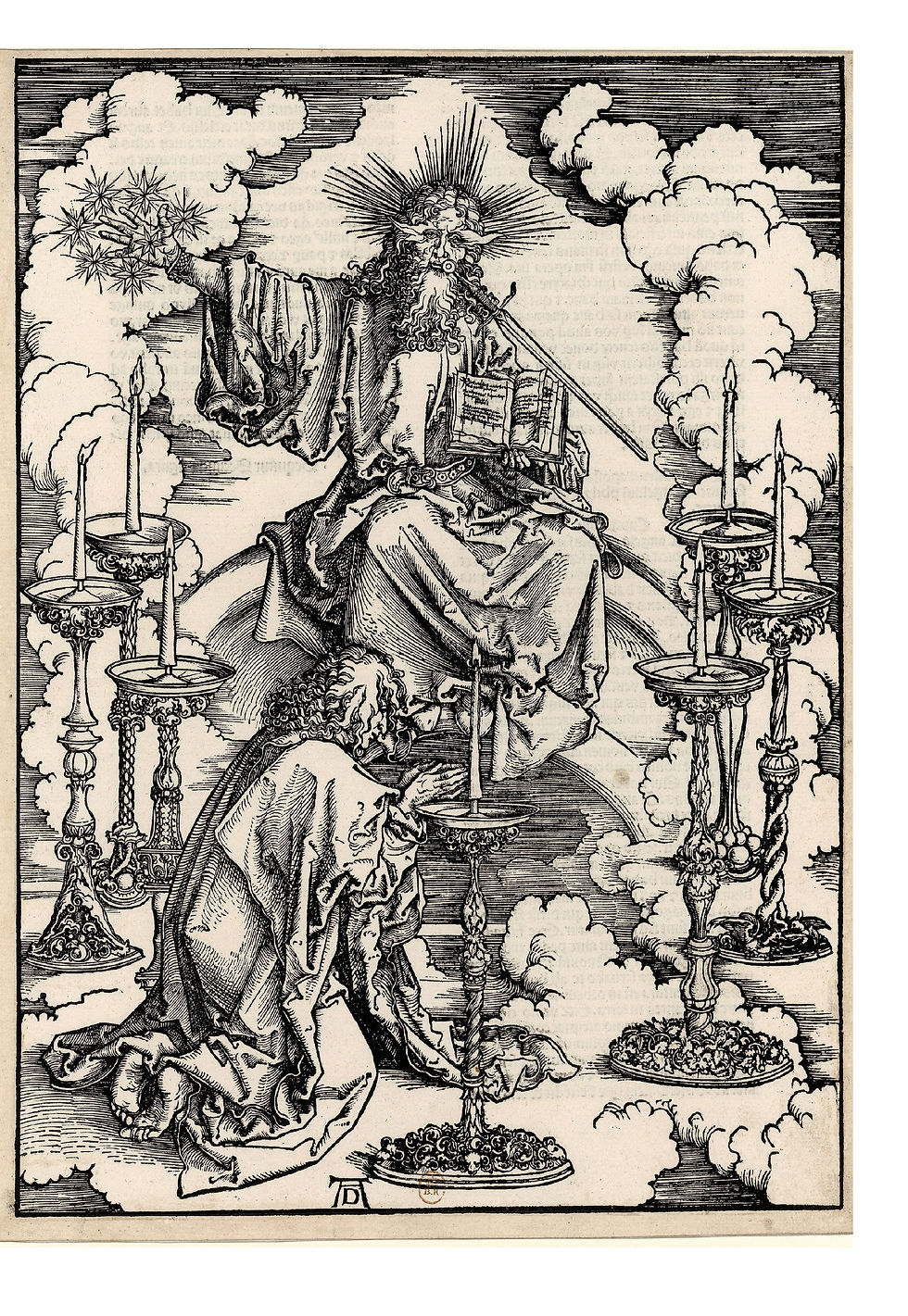
“The Vision of the Seven Candlesticks” (or chandeliers) is from Revelation 1. John sees Christ standing among seven golden lampstands, holding seven stars.
Each lampstand = a church in Asia.Each star = an angel or spirit of a church.Christ appears radiant, eternal, judging—"eyes like fire, voice like rushing waters."
It’s the start of the apocalypse: Christ reveals he’s watching, and judgment is coming. A cosmic warning to the churches to stay faithful—or perish.
The figure sitting in front of Jesus in that scene is John himself—the visionary, the witness.
In Revelation 1:17, when John sees Christ in glory, he falls “as though dead” at his feet. He’s overwhelmed by divine majesty.
He’s not confronting Christ—he’s crushed by the vision, paralyzed by awe and fear. A mortal in front of the infinite.
3. St John kneeling before Christ and the twenty-four elders

“Saint Jean devant Dieu et les Vieillards” (Saint John before God and the Elders) is based on Revelation 4.
John is taken into heaven and sees:– God on a throne, surrounded by light and thunder– 24 Elders, dressed in white with golden crowns– They worship God, casting their crowns before Him– Four living creatures (lion, ox, man, eagle) cry “Holy, holy, holy…”
The four living creatures in Revelation 4 represent different aspects of creation:
Lion – symbolizes strength and majesty (often associated with kingship).
Ox – represents service and sacrifice (often associated with labor).
Man – signifies intelligence and humanity.
Eagle – embodies spirituality and freedom, soaring toward the divine.
Together, they represent the fullness of creation, constantly praising God.
In the scene where Jesus, the Lamb, sits on the throne, there’s a moment where John sees the Lamb as if slain, with seven horns and seven eyes (representing perfect power and divine knowledge). This imagery is often linked to the concept of sacrifice and the atoning Lamb.
It’s a celestial court—God as king, judgment beginning. John isn’t passive now—he’s the guest, the witness of glory before chaos unfolds.
4. The four horsemen of the Apocalypse

Les Quatre Cavaliers de l’Apocalypse (The Four Horsemen of the Apocalypse) come from Revelation 6.
Each horseman is released when the Lamb (Christ) opens the first four seals of a divine scroll. They symbolize escalating global chaos:
White Horse – Conquest or false peace (rider with a bow and crown).
Red Horse – War (rider with a sword, takes peace from the Earth).
Black Horse – Famine (rider with scales, measuring food in scarcity).
Pale Horse – Death (rider named Death, followed by Hades).
Dürer’s woodcut turns them into a violent storm crashing over humanity—divine judgment in motion.
5. The opening of the fifth and sixth seals

L’ouverture du cinquième sceau (Revelation 6:9–11):John sees souls of martyrs under the altar, crying out for justice.They’re told to wait—more will die before judgment is complete.It’s a moment of holy suspense: blood has been shed, but vengeance is postponed.
L’ouverture du sixième sceau (Revelation 6:12–17):Cosmic catastrophe explodes:– Great earthquake– Sun turns black– Moon becomes blood– Stars fall– Sky vanishes– Mountains and islands shift
All—kings and slaves—hide in terror, crying to the rocks:“Who can stand before the wrath of the Lamb?”
It's the rupture of the natural order. Heaven breaks open.
6. Four angels holding back the winds, and the marking of the elect

Les Quatre Anges retenant les vents – from Revelation 7:1.
John sees four angels standing at the four corners of the Earth, holding back the four winds—symbols of destruction.
They delay chaos until the servants of God are sealed on their foreheads—a mark of protection.
This scene is a pause in the apocalypse. Like a divine breath held. Judgment is coming, but the innocent must be marked first. Calm before the storm.
Les sept anges avec les trompettes

Les Sept Anges avec les Trompettes – Revelation 8–11.
Seven angels stand before God, each given a trumpet.Each blast triggers a disaster—escalating divine punishments:
Hail and fire burn earth.
Mountain of fire falls into the sea—turns it to blood.
Wormwood (a star) poisons rivers.
Sun, moon, stars darken.
Locusts from the abyss torture humans.
Four angels of death kill a third of humanity.
Heaven opens—God’s reign declared.
The trumpets are alarms of the end, each louder, more terrifying than the last. An opera of cosmic violence.
Les Quatre Anges Vengeurs – Revelation 9:14–15.

They are bound at the Euphrates River, released at the sixth trumpet.
Their mission: kill a third of humanity.They lead an army of 200 million monstrous cavalry—fire, smoke, sulfur pour from their mouths.
They are not angels of mercy—they are instruments of divine wrath, cold, precise, unleashed at the appointed hour. Not fallen, but obeying.
Planche 9 of Dürer’s Apocalypse series is titled “Les Quatre Anges Vengeurs” (The Four Angels of the Euphrates).
In the image:– The four angels stand, released from bondage, commanding a terrifying army.– Below, humans are slaughtered, trampled, engulfed in chaos.– The horsemen have grotesque, almost chimera-like features—with lion heads, fire-breathing mouths.
Dürer captures the violence with surgical intensity: divine justice as massacre, righteous but inhuman.The angels are calm, while humans writhe—a contrast between eternal will and mortal terror.
It’s not just judgment—it’s the cold machinery of fate.
Planche 10 – Saint Jean dévorant le livre comes from Revelation 10.

John is told by an angel to take a little book and eat it.– In his mouth: sweet as honey– In his stomach: bitter
The angel says: “You must prophesy again…”It’s a metaphor: the truth of God is beautiful, but its consequences—judgment, exile, death—are painful.
Dürer shows the angel, immense and radiant, and John—kneeling, obedient, receiving the mysterious book.
It’s about the burden of knowledge, the price of vision. Sweet to see, bitter to carry.
Planche 11 – La Femme vêtue du Soleil et le Dragon is from Revelation 12.

A woman, clothed with the sun, moon at her feet, crowned with twelve stars, is in labor.
A red dragon with seven heads waits to devour her child at birth.– The child is caught up to God– The woman flees into the wilderness, protected
The dragon = Satan, fallen cosmic power.The woman = Israel, the Church, or Mary, depending on interpretation.
Dürer’s engraving is charged with tension—celestial motherhood vs. apocalyptic threat.It’s the eternal myth: birth of hope in the jaws of evil.
Planche 12 – Saint Michel et le Dragon (Saint Michael and the Dragon) comes from Revelation 12:7–9.

In this scene, Saint Michael, the archangel, leads heaven’s armies in a cosmic battle against Satan (the dragon) and his forces.– Michael defeats the dragon and casts him out of heaven.– Satan is thrown down to earth, where he continues to rage in his rebellion.
Dürer’s engraving shows Michael as a powerful warrior, trampling the dragon underfoot, sword raised in victory.The dragon, writhing, is depicted in chaotic defeat.
It’s the final battle between good and evil, a symbol of divine triumph over chaos and corruption.
4o mini
Planche 13 – La Bête aux cornes de bélier comes from Revelation 13:1–10.

This image shows one of the two beasts described in the chapter:– The beast with ten horns and seven heads, rising from the sea, is a symbol of political and worldly power that opposes God.– The ram’s horns could symbolize strength and aggression—a vicious creature intent on war and control.– The beast is worshipped by the masses, representing the false authority of tyrants.
Dürer’s engraving depicts the beast as a horrific, multi-headed monster, emphasizing its power and the evil influence it exerts over humanity.
It’s the embodiment of oppression and blasphemy—the forces of darkness in direct opposition to the divine.
In Planche 13 – La Bête aux cornes de bélier, besides the primary beast with the ram’s horns, there are additional creatures and symbols from Revelation 13 that Dürer may have incorporated:
The First Beast – The multi-headed, ten-horned beast from the sea, symbolizing political power, corruption, and worldly kingdoms that wage war against the saints and try to impose false worship. It has blasphemous names on its heads and is given power by the dragon (Satan).
The Second Beast (The False Prophet) – It rises from the earth (Revelation 13:11). This beast has two horns like a lamb but speaks like a dragon, representing deception and false religion. It causes people to worship the first beast and sets up the infamous mark of the beast.
The Mark of the Beast (666) – Although not depicted as a creature, the number 666 is crucial here. It is the number of the beast, which people must accept to buy or sell, symbolizing total submission to worldly power.
These creatures represent evil forces—both political and spiritual—designed to deceive and enslave humanity, turning them away from God. In Dürer's engraving, the creatures are portrayed as terrifying, grotesque symbols of persecution and tyranny.
Planche 14 – L’Adoration de l’Agneau is based on Revelation 5,

Planche 14 – L’Adoration de l’Agneau is based on Revelation 5, where John sees the Lamb (Jesus) as the only one worthy to open the sealed scroll that holds the secrets of the end times.
In this scene:– The Lamb is depicted as slain, yet standing, representing Christ’s sacrifice and victory over death.– Around the Lamb are the twenty-four elders (representing the twelve tribes of Israel and the twelve apostles), worshiping and casting their crowns before Him.– There are also four living creatures (lion, ox, man, eagle) that continually worship the Lamb.
Dürer’s engraving captures the reverence and sacred awe in the worship of the Lamb. It’s a moment of divine praise, recognizing Christ as the only one capable of bringing redemption and salvation. The focus on the Lamb is both a symbol of humility and divine power, showing His role as both sacrificial lamb and conqueror of evil.
In Planche 14 – L’Adoration de l’Agneau, the figure kneeling at the bottom is likely John the Apostle, the one who is witnessing and recording the divine vision in the Book of Revelation.
John is often depicted as humble and reverent in his visions, and his position on his knees shows his awe and submission before the Lamb (Jesus Christ), the central figure in the scene. His posture emphasizes the profound humility and reverence he feels in witnessing the heavenly adoration of the Lamb, reflecting his role as the recipient of divine revelation.
Planche 15 – La Grande Prostituée de Babylone is based on Revelation 17, where the Great Whore of Babylon is depicted.

In this vision:
The woman is shown riding a beast with seven heads and ten horns, a symbol of the corrupt political system aligned with evil.
She is dressed in purple and scarlet, adorned with gold, precious stones, and a golden cup, full of abominations and filth—representing luxury, decadence, and sinful indulgence.
On her forehead is written: “Mystery, Babylon the Great, the Mother of Prostitutes and Abominations of the Earth”—a title signifying her corruption and spiritual adultery.
The beast she rides represents the worldly powers that are complicit in her idolatry and oppression. The destruction of Babylon is foretold—this woman symbolizes the false religion, materialism, and idolatry that leads to the downfall of nations.
Dürer’s engraving shows her as a powerful and alluring figure, sitting on the beast, signifying the dangerous alliance of political and spiritual corruption that leads people away from God, consumed by their own self-interest and sins.
Planche 16 – L’Ange avec la clé de l’abîme is inspired by Revelation 20:1-3.

In this scene, an angel descends from heaven holding the key to the Abyss (or bottomless pit) and a great chain. The angel binds Satan—the great deceiver—and casts him into the Abyss, locking it and sealing it for 1,000 years to prevent him from deceiving the nations during this time.
The imagery is of divine authority over evil, a moment of triumph over Satan’s influence on the world. The angel’s commanding stance with the key symbolizes the sovereignty of God in the battle against evil.
Dürer’s engraving emphasizes the final defeat of Satan—he is pictured as subjugated and helpless, with the chains binding him, symbolizing the ultimate power of divine justice.
Comments